
Formatori
Artificial Intelligence and Ignatian Pedagogy
From discernment to perspectives of experimentation in schools
What changes in the way we know, think, teach, and learn, but also act and make choices, when artificial intelligence enters the life of the school? And, above all, what idea of the person and of education guides our choices? Around these questions, the thematic seminar «Artificial Intelligence and Ignatian Pedagogy» was developed, promoted by CeFAEGI.EUM ETS, the training body of the schools of the Jesuit Education Foundation of the Euro-Mediterranean Province, and held in Milan from November 17 to 20, 2026.
Representatives from schools in Turin, Rome, Milan, Malta, and Palermo took part, along with the International School Palermo. Accompanying the journey were Fr. Vitangelo Carlo Maria Denora SJ, president of CeFAEGI.EUM ETS, and the team's trainers, Prof. Veronica Petito and Prof. Sabrina Maineri.
This was not simply an update on the application of AI, nor a discussion limited to the risks of its use. The challenge was to understand a cultural transformation that changes the relationship with knowledge and challenges the educational mission, recognizing both the new possibilities offered by technology and what it cannot replace. The very structure of the seminar translated this intention into method: context, experience, reflection, action, and evaluation- the steps of the Ignatian Pedagogical Paradigm (IPP) - did not remain mere themes to be explained, but guided the rhythm of the participants' work.
The journey began by listening to the real context: knowledge, questions, personal and educational uses of AI, and teachers' perceptions regarding students' practices. The discussion with an alumnus, in the form of reverse mentoring, also introduced the perspective
of those who experience technology from within their daily habits. The dystopian exercise on the «school of 2040», developed during the seminar, transformed concerns into pedagogical questions: behind the fear of a dehumanized school, what do we feel the
need to protect? What relationships, times, and opportunities for growth do we not want to lose?
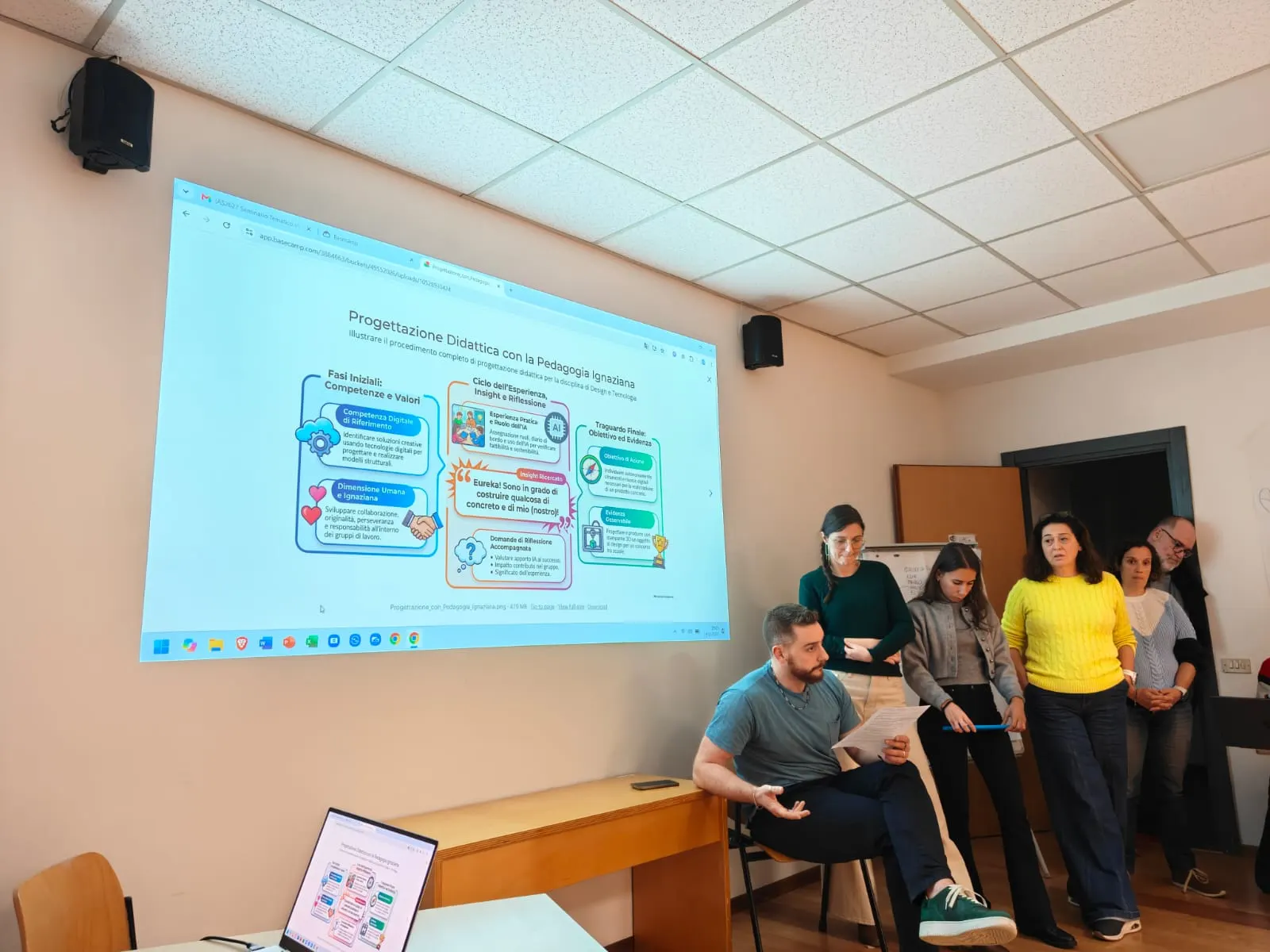
The experience stage then directly involved the participants. The contribution of journalist and trainer Domenico Maria Jacobone accompanied the workshop activities: tackling a task first independently and then with AI, exploring a cultural issue through successive questions, observing how the tool can expand research and support elaboration. In the afternoon, AI was put to the test as a critical interlocutor, capable of offering objections and counter-arguments to a personally developed position. The discussion with Professor Tommaso Agasisti, full professor at the Politecnico di Milano, enriched the dialogue between research, schools, and educational practices. The point was not to measure who produced the best result, but to recognize where understanding, judgment, and responsibility lie.
It is on this ground that reflection took on a genuinely anthropological depth.
The cross-cutting reinterpretation of «Magnifica Humanitas», placed in dialogue with the Ignatian Pedagogical Paradigm and with the possibilities of using AI, accompanied the discernment, offering a perspective capable of avoiding both demonization and
the idolatry of technology. Limit, in this perspective, is not simply a deficiency to be corrected through increasingly efficient performance: it belongs to the human condition, to its vulnerability, and to its openness to relationships. Education cannot, therefore, be reduced to the speed of answers or the quality of a product; it requires interiority, time, dialogue, and the ability to give meaning to what is learned.
Hence a crucial question that ran through the exercises: what is appropriate to delegate to AI, what can be delegated only under certain conditions, and what must remain entrusted to the person? The «delegation map» made this distinction concrete. It is not a matter of establishing abstract prohibitions, but of evaluating at which point in a teaching sequence the use of AI supports learning and when, instead, it risks depriving the student of the very experience of understanding, asking questions, reasoning, and
choosing. The criterion is not solely the effectiveness of the tool, but the formative value of the process.
Reflection was thus translated into design. Starting both from new educational and pedagogical questions and from tasks already tested in the classroom, the groups explored three perspectives—without AI, with AI, with AI accompanied by reflection—to reflect on
the learning outcomes genuinely desired. As a result, hypotheses for teaching units emerged in which the IPP guides the integration of technology. A dual need clearly emerged: to rethink teaching, in its methods and activities, and to protect the broader educational intentionality, which concerns the formation of the person, relationships, freedom, and the common good.
In the final phase of the journey, work focused on action and evaluation, according to the framework of the Ignatian Pedagogical Paradigm. The discussion with the guidelines of the dossier «Education and technology. Reflections and operational indications», prepared for the Istituto Leone XIII by Tommaso Agasisti and Mariavittoria Ludovico, also supported the transition from questions to choices. The participants, grouped by school, identified potential areas of experimentation, learning objectives, pedagogical criteria, and methods for documenting and evaluating experiences. The shared intention is to continue the work within faculty bodies, testing in the field what AI makes possible and under what conditions it can contribute to a more conscious education.
From this shared research also emerged the «Manifesto of an Algor-ethics for the schools of the F.G.E.», structured in ten points: not a repertoire of technical prescriptions, but a set of guidelines to inhabit change responsibly. At the center are the dignity and uniqueness of each student, the irreplaceable nature of the educational relationship, discernment in choices, the primacy of process over product, the value of time and effort in learning, critical thinking, creativity, the educating community, and care for limits. The Manifesto expresses a conviction developed through experience: innovation is educational only when it remains at the service of the integral growth of the person.
The seminar thus concluded without claiming to exhaust an issue destined to evolve and raise new challenges and questions. However, it opened a shared workspace: experimenting, observing, reflecting anew, and discerning. It is precisely from this perspective that the Ignatian Pedagogical Paradigm offers a significant contribution to facing the transformations introduced by artificial intelligence: recognizing in experience not merely a learning opportunity, but a process of understanding and inner engagement; in reflection, the space to question the meaning and value of what is known; in action, the ability to translate discernment into conscious and responsible choices. The task of translating these insights into educational practices remains open, as we continue to reflect on what the present time asks of our schools.
Gallery
5 photos
Continua a leggere
Comments
Loading comments…